
When buyers source OPP bags, size is usually the first specification they ask about. Thickness often comes next.
In practice, thickness can make just as much difference.
A lightweight T-shirt, a pair of jeans and a jewelry card may all fit inside clear OPP packaging, but they do not put the same pressure on the film. A thin bag may work perfectly for underwear and fail quickly when used for a rigid accessory with sharp corners.
So the useful question is not simply whether a bag is “thick enough.” Buyers need to know how many microns are suitable for the actual product, packing method and handling conditions.
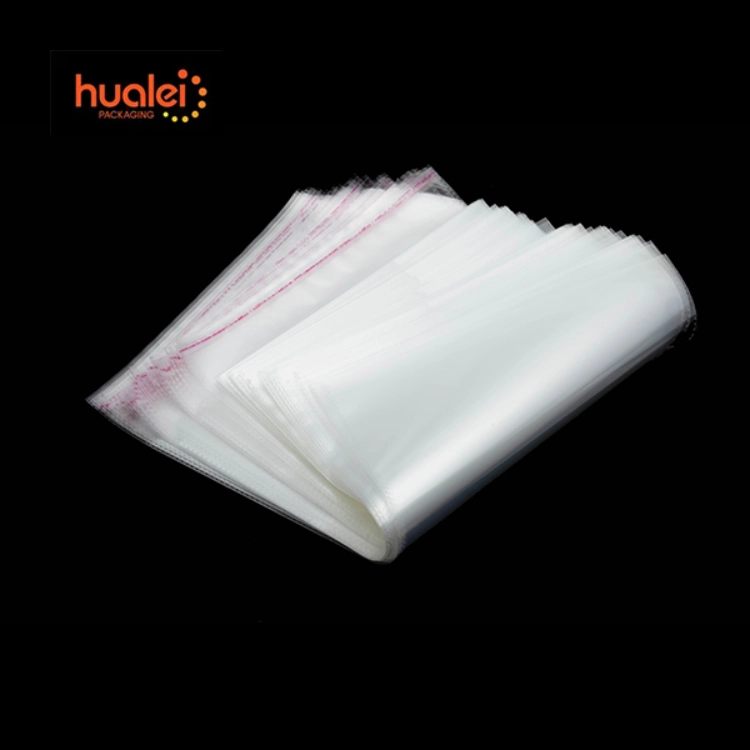
Yiwu Hualei Packaging supplies OPP bags in several thicknesses for clothing, jewelry, accessories and retail packaging. Its OPP Bag Clothing range includes 17, 22, 25, 30, 35, 40, 45 and 53 mic options. These choices allow buyers to match OPP bag thickness to different product weights and packaging needs.
What Does Micron Mean in OPP Bag Packaging?
A micron, or μm, is a unit used to describe film thickness.
The higher the micron number, the thicker the film.
That does not mean the thickest bag is always the best bag. OPP bag performance also depends on bag size, product shape, seal strength, printing, closure style and how the packed product will be transported.
OPP and BOPP materials are widely used because they combine transparency, rigidity and useful mechanical strength. Hualei’s technical information describes BOPP film as having high tensile strength, impact strength, rigidity, toughness and good transparency.
These properties make OPP bag packaging suitable for clothing, accessories, stationery, gifts, cosmetics and many other retail products.
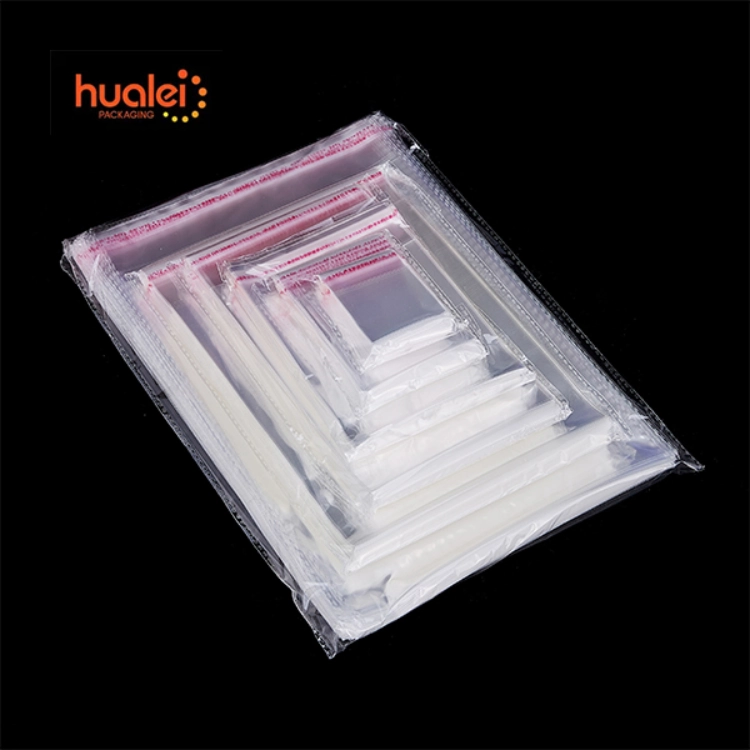
Size still matters alongside thickness. Buyers who are unsure about the correct OPP size can also refer to Hualei’s previous OPP Plastic Bag Size Chart for Clothing and Retail Packaging.
How Many Microns Do You Need for an OPP Bag?
There is no single micron specification for every application.
For Hualei’s standard OPP clothing bags, the available thickness range runs from 17 mic to 53 mic. Its existing product information gives a useful starting point: 17 mic for lightweight T-shirts or underwear, 22 mic for normal clothing, 25 mic for slightly heavier products and 35 mic for bulkier garments such as jeans.
A practical selection chart is:
| OPP Bag Thickness | Common Packaging Use | Main Consideration |
| 17 mic | Underwear, light T-shirts, small lightweight items | Suitable when products are soft and have no sharp edges |
| 22 mic | General clothing and small retail goods | A common starting point for standard OPP bag packing |
| 25 mic | Heavier garments, accessories, jewelry cards | Adds more strength without using very heavy film |
| 30 mic | Retail goods requiring more handling resistance | Useful for repeated packing and handling |
| 35 mic | Jeans, thicker garments and heavier accessories | Better for bulkier products |
| 40 mic | Heavy retail products | More body and resistance during transport |
| 45 mic | Products requiring higher protection | Useful when contents have firm edges or rough handling is expected |
| 53 mic | Extra-heavy-duty OPP packaging | Best where maximum strength in this range is required |
These figures are not fixed rules for every package. Product shape can change the answer quickly.
A smooth folded shirt may work well in a lighter bag. A small metal accessory can puncture the same film because pressure is concentrated on one sharp point.
What OPP Bag Thickness Is Suitable for Clothing?
Clothing is one of the clearest examples of why buyers should not use one thickness for every SKU.
17 to 22 Mic for Lightweight Clothing
For underwear, lightweight shirts and thin garments, 17 mic can work when the main purpose of the bag is keeping the product clean, organized and visible.
The products are soft and normally do not press hard against the side seals.
Hualei describes 17 mic as suitable for single T-shirts or undergarments, while 22 mic is a standard thickness for most clothing.
For large wholesale orders, using an unnecessarily thick bag can also increase material use and packaging cost. If a 22 mic bag performs well during packing and shipping, there may be no reason to move every lightweight garment to 35 or 40 mic.
25 to 35 Mic for Jeans and Heavier Garments
Jeans, sweatshirts, trousers and thicker folded clothes create more pressure inside the bag.
They are heavier and their folded corners push more strongly against the film. Workers may also pull the bag harder during packing.
For this type of OPP bag packing, 25, 30 or 35 mic is often more practical.
Hualei’s OPP Bag Clothing with Multiple Thickness Options is made for T-shirts, jeans, slippers, underwear and other apparel. Standard sizes range from 18 × 30 + 4 cm to 40 × 60 + 4 cm, and customer logos and designs can also be printed.
Buyers should therefore consider OPP plastic sizes and thickness together rather than choosing the two specifications separately.
40 to 53 Mic for Higher Protection
Thicker options such as 40, 45 and 53 mic are more relevant for bulky garments, heavier packs or products that go through more demanding handling.
They give the film more body, but using 53 mic for every garment is usually unnecessary.
The better approach is to test the actual packed product. If a 30 or 35 mic bag handles filling, carton packing, shipping and unpacking without tearing, a thicker specification may only increase cost.
How Thick Should OPP Bags Be for Jewelry?
Jewelry creates a different problem.
The total weight can be very low, but metal parts may create sharp pressure points.
Earring posts, clasps, pendants, chains and the corners of jewelry cards can press directly against the film.
17 to 22 Mic for Small Smooth Items
Small accessories without sharp edges can use lighter OPP packaging.
Hualei’s OPP polka dot printing bags, for example, are designed for jewelry, gifts and small accessories. Sizes include 3 × 4 + 2 cm, 4 × 4 + 2 cm, 6 × 7 + 2 cm and larger options, while thicknesses range from 17 to 53 mic.
A 22 mic bag can be a useful starting point for lightweight jewelry, especially when pieces are fixed securely to a card.
25 to 35 Mic for Jewelry With Hard Edges
If the package contains metal edges, several pieces or a relatively stiff backing card, 25 or 30 mic gives more protection.
This matters because jewelry packaging is handled many times. Products may be packed at the factory, placed into cartons, sorted in a warehouse, unpacked by a retailer and then handled again on the shelf.
The bag needs to survive the complete supply chain.
Hanging Jewelry Also Needs the Right Bag Structure
For products displayed on retail pegs, micron thickness is only part of the decision.
The header matters too.
Hualei’s OPP Card Head Bag for Jewelry and Retail Display uses a card head hanging hole so jewelry, accessories, gifts and other small products can be placed on hooks or display racks. It also offers self-adhesive closure, custom printing and thicknesses from 17 to 53 mic.
For these products, buyers should consider film thickness, product weight and the hanging structure together.
What OPP Bag Thickness Works for Retail Packaging?
“Retail packaging” covers a very wide range of products, so there is no useful rule saying that every retail bag should be 25 or 30 mic.
A better way is to look at how the product behaves inside the bag.
Light and Flat Retail Products
Printed items, small fabric products, stationery and soft accessories normally place little stress on the film.
A 17 or 22 mic bag may already provide enough transparency, dust protection and basic handling strength.
In these cases, correct OPP size, sealing and appearance may matter more than adding extra thickness.
Retail Products With Cards or Rigid Parts
A backing card, instruction sheet, plastic fitting or metal part changes the situation.
The product may remain lightweight, but rigid edges can rub against one area of film during transport.
For this type of packaging, 25 or 30 mic is worth testing.
If the product needs hanging display, an OPP Card Head Bag may also make more sense than modifying a standard self-adhesive bag.
Heavy or Large Retail Packs
Multipacks, larger accessories and products that move inside the bag may require 35 mic or more.
Again, the specification should be tested at the actual bag dimensions.
A large bag and a small bag made from the same micron film will not behave exactly the same way once products are packed inside.
Does a Thicker OPP Bag Mean Better Quality?
Not necessarily.
Thickness is one specification. Quality depends on several things working together.
A good OPP bag also needs stable dimensions, clean sealing, good transparency and enough strength for the intended product.
OPP film itself offers higher tensile strength, stiffness, transparency, gloss and printability than ordinary PP film.
Adding more microns cannot fix every problem.
A bag that is too small can still split. A sharp product can still puncture it. A poor seal can still fail.
This is why buyers should evaluate the whole pack rather than judging quality from one number.
For more information on clear packaging and adhesive closures, Hualei’s earlier article Why Choose OPP Bag Packing for Clear, Self-Adhesive Packaging Solutions? explains the basic relationship between OPP bag packaging, visibility and self-adhesive sealing.
How Should Wholesale Buyers Test OPP Bag Thickness?
Start with the real product.
For clothing, fold it exactly as it will be packed. For jewelry, use the actual jewelry card. Add labels, instructions and other inserts before measuring the final pack.
Then choose an initial micron range.
Once samples arrive, fill several bags and handle them normally. Place them into the intended carton, stack them, remove them and inspect the film.
Pay attention to:
- stress around side seals;
- punctures caused by corners;
- stretching around bulky products;
- adhesive flap performance;
- clarity after handling;
- fit around the finished product.
An empty sample tells you very little.
Custom printing also needs to be discussed before bulk production. Hualei’s OPP clothing bags and card head bags can both be printed with customer logos and designs.
Buyers sourcing several formats can view the broader Hualei OPP Bag Product Range, which covers clothing bags, card head bags, printed OPP bags and other clear packaging options.
Which Hualei Products Fit This Thickness Guide?
For clothing and small retail products, Hualei’s OPP Bag Clothing and OPP card head bag cover two common packaging needs.
The first is OPP Bag Clothing.
It is designed for T-shirts, jeans, slippers, underwear and similar apparel. Available thicknesses range from 17 to 53 mic, giving wholesale buyers several options for light and heavy garments. Custom logo and design printing are also supported.
Buyers can check the OPP Bag Clothing specifications before matching a thickness to individual apparel SKUs.
The second is OPP card head bag.
This format is more suitable for jewelry, accessories and small retail items that need hanging display. The card head provides a hanging point while the transparent body keeps the product visible.
Both products are part of Hualei’s OPP packaging range. The wider product catalog also includes other packaging formats such as PE bags, CPP bags, zipper bags and BOPP film.
What Information Should You Give the Factory Before Ordering?
A request saying “I need a clear OPP bag” is not enough for an accurate quotation.
At minimum, provide:
product type, finished bag size, preferred micron thickness, closure style, printing requirement and order quantity.
For clothing, explain how the garment is folded.
For jewelry, mention backing cards and sharp metal parts.
For retail products, tell the factory whether the package will hang on a peg, lie flat or be packed inside another shipping carton.
If you are not sure which thickness to choose, send the packed product dimensions and describe the actual use. The supplier can then recommend a starting specification for sampling.
Yiwu Hualei Packaging supplies BOPP bags, PE bags, CPP bags, printing bags, zipper bags, flower film and BOPP film. Buyers can learn more about the company through its About Us page or contact Hualei Packaging with product dimensions and custom packaging requirements.
Final Thoughts
There is no single best OPP bag thickness.
For lightweight clothing, 17 or 22 mic may be enough. Jeans and heavier garments may need 25 to 35 mic. Jewelry requires more attention to sharp edges and backing cards. Larger retail products or packages exposed to heavier handling may need 40 mic or above.
The simplest way to choose is to look at the actual packed product.
Check its weight, shape, edges and OPP plastic sizes. Think about how it will be sealed, shipped and displayed. Then test a real sample before placing the bulk order.
That is much more reliable than simply choosing the thickest OPP bag available.
FAQs
What Is the Standard Thickness of an OPP Bag?
There is no single standard thickness for every OPP bag. Hualei offers OPP packaging in 17, 22, 25, 30, 35, 40, 45 and 53 mic options. Lightweight products can use thinner film, while heavier or harder products normally need more strength. The right choice depends on product weight, shape, bag size and handling conditions.
Is 22 Mic Thick Enough for Clothing Packaging?
For many lightweight garments, yes. Hualei lists 22 mic as a standard thickness for most clothing, while 17 mic can be used for lightweight items such as single T-shirts and underwear.
For jeans, sweatshirts or thicker folded clothing, buyers may want to test 25, 30 or 35 mic instead. The OPP Bag Clothing range provides several thickness choices for different apparel products.
What OPP Bag Thickness Is Best for Jewelry?
Small and smooth jewelry can often start around 22 mic, but there is no fixed specification for every item.
Earring posts, clasps, metal corners and jewelry cards can create concentrated pressure on the film. For products with harder or sharper parts, 25 to 35 mic may provide a better margin during packing and transport.
If jewelry will be displayed on retail hooks, an OPP card head bag may also be more suitable than a normal self-adhesive bag.
Is a Higher Micron OPP Bag Always Stronger?
A thicker film generally provides more material and greater resistance, but micron thickness alone does not determine bag quality.
Seal quality, bag dimensions, film consistency and product shape also matter. A thick bag can still fail if it is too small for the product or if a sharp corner repeatedly presses against one point.
That is why wholesale buyers should test the complete packed product instead of judging an OPP bag only by its micron number.