
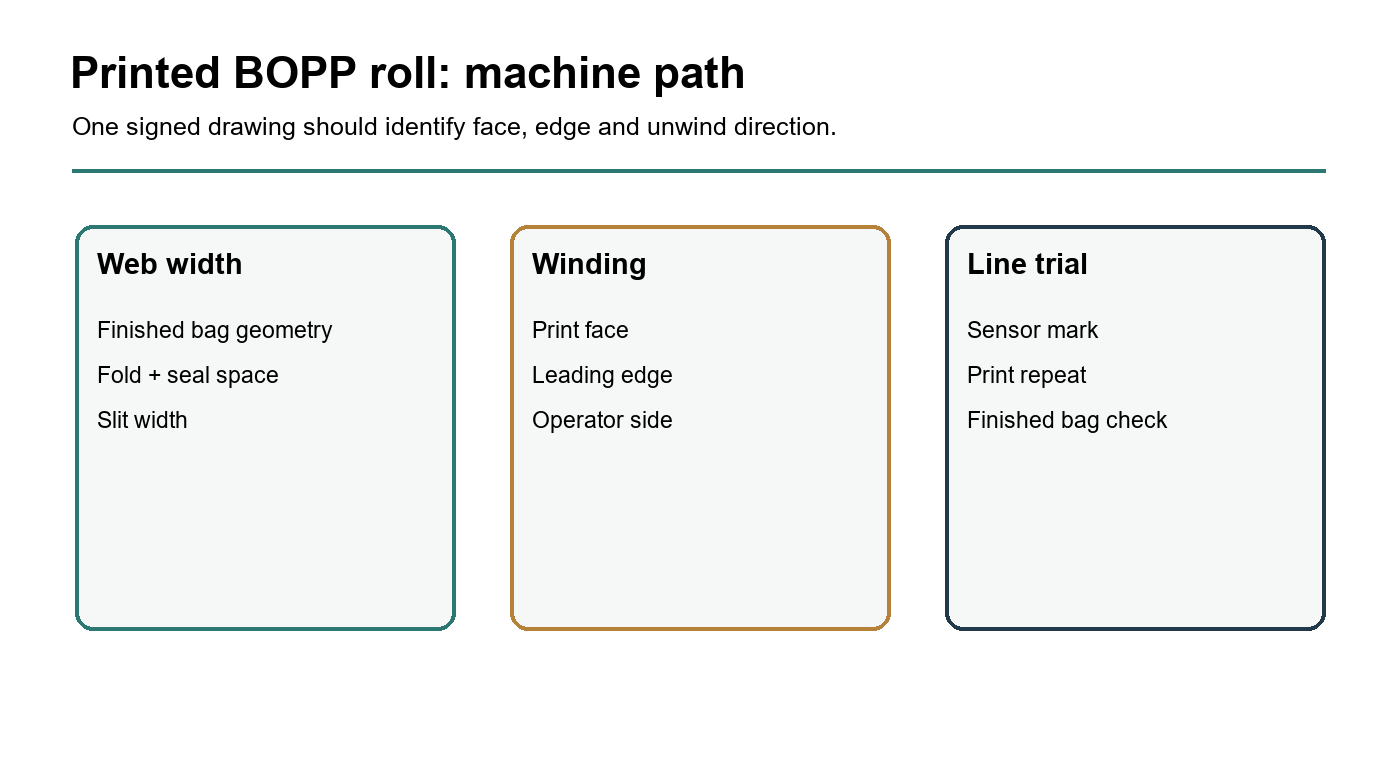
“Print on the outside” sounds clear until the roll reaches the unwind stand. Which face is outside as the film leaves the roll? Which face ends up outside after the web folds into a bag? The answers can differ. For a printed BOPP roll film order, put a physical orientation sample next to the artwork. A beautiful proof is little comfort when the finished bags come off upside down.
At a glance: approve the delivered web width, print face, unwind direction and registration position against the same machine-path drawing before buying a production roll.

Map the machine path first
Take a short strip from the film already approved on the line, if there is one. Mark the face nearest the operator, the leading edge and the direction of travel. Walk it through the planned folds by hand. “Left” and “right” are unreliable once someone stands on the other side of the machine; arrows on the strip survive that change of viewpoint.
- Web widthis the width of film delivered to the converter after any slitting, distinct from the finished bag panel.
- Print faceis the film surface that carries the artwork as it reaches the unwind stand.
- Registration markis the printed target used by a sensor to align the cut or seal with the artwork.
The Flexographic Technical Association’s bag-machine guidance describes unwinding, web-tension control, folding and print registration as linked parts of converting. A marked strip gives the buyer and operator a shared reference for that path.
Hualei offers custom OPP and BOPP roll film for bag-making, flower packaging, bread packaging and other retail uses, with custom printing, width and thickness options. A converter should name the intended application and machine path before asking for a quote. “BOPP roll film” alone leaves too many choices open.
Calculate usable web width, not just nominal width
Include trim and sealing allowances
Master-roll width, delivered slit width and finished-bag width are three different measurements. Label all three. If a purchase order says only “30 cm wide,” the supplier and the converter may each be picturing a different stage. Show which edge is trimmed, how many lanes will be slit and what the machine needs for sealing. Those allowances belong to this equipment and bag structure; copying a generic number is a poor shortcut.
For example, suppose a side-sealed bag has two 30 cm faces and needs 1 cm at each outside seal. Those elements already total 62 cm, before trim or any other allowance. This is only a sketch calculation, not a quoted web width. Have the converter draw the actual fold and slitting plan rather than use a multiplier copied from another job.
Hualei offers roll-film widths from 5 to 180 cm and custom sizes by request. That range does not confirm that every width, film grade and printed repeat can be supplied in every combination. Send the final web calculation and ask for a specific production confirmation. If multiple bag widths are planned, list each finished slit roll separately.
Identify the edge used for control
Which edge does the line guide against? Mark it on the orientation strip. An artwork proof can place the registration mark on the other edge, where the sensor cannot read it or the slitter will remove it. The machine operator should name the reference edge before printing begins. Keep the mark location in the signed proof, not in a follow-up message.
Approve artwork with winding direction
An artwork PDF shows the design. It rarely tells the operator how the roll will arrive. Add unwind arrows, print face, leading edge, operator side and a sketch of the finished front. Hold the proof beside the sample strip. If that comparison still needs a long verbal explanation, the drawing needs work.
Look at the boundary between one printed repeat and the next. Does the barcode still sit on a readable panel after the bag folds? Where does the logo land at the cut? A single centered image on a PDF hides these points; the repeating web does not. Put repeat length beside the machine’s cut-and-seal cycle on the drawing.
If the chosen process is flexographic, ISO 12647-6 sets out the exchange of color aims and related information for packaging print. Use the printer’s agreed proof and process specification alongside the mechanical winding drawing. A color approval cannot resolve a misoriented web.
The sealing jaw adds another orientation check. The Hualei roll-film product includes a heat-sealing film option. Ask which quoted grade has that surface and mark the seal face on the strip. Do not carry a successful trial from one grade over to another simply because both are called BOPP. The production roll needs the same construction as the tested roll.
Run a short line trial before a bulk order
The line trial should include both the first thread-up and a period after the web has stabilized. Keep finished bags from several points along that run, in order, and compare the print position on each. A registration mark that needs constant sensor adjustment or a logo that creeps toward a seal is a different result from a single bad first bag. Save the imperfect samples with the machine settings; the best-looking one cannot describe the whole trial.
Inspect film and finished bags
Thickness should be checked on the delivered material rather than inferred from a catalog option. NIST’s plastic-sheet measurement procedure illustrates taking readings at multiple positions across a sample. It is a measurement reference, not a claim that this order is subject to that handbook. Agree on the inspection method with the converter before the trial.
Recheck after a change
Hualei lists thickness options of 17, 22, 25, 30, 35, 40, 45 and 53 microns for its OPP/BOPP roll-film range, along with custom printing. Select a trial option by the planned converting and pack performance, then verify the actual roll. The roll-film category shows related formats, but the signed specification should point to the exact grade and finished roll configuration chosen for the line.
At the unwind stand, a clear BOPP roll intended for flower wrap could look much like the heat-sealing grade a bag maker needs. Hualei lists both flower and bread packaging uses, plus bag making, within its roll-film range. That shared brand name does not make the grades interchangeable. Ask for the grade on the roll label and test the intended seal. Custom logo or design printing is possible; mark the finished bag panel and fold on a strip before the artwork is approved.
Hualei gives 10,000 meters as a starting bulk-roll quantity and says the film is wound and packed for transit. Break that total into the slit widths, core size and outer-roll limits the converter can actually run. The published width span is 5–180 cm, with custom sizes by request. Send a drawing of each delivered roll rather than a single combined meter figure. Confirm the current minimum for the quoted grade and any trial run.
Put the approved configuration on one purchase sheet
The purchase sheet should identify the tested film grade, seal construction and thickness. Give master width and delivered slit width their own boxes. Add the core and outer-roll limits from the machine, print face, unwind arrows, repeat length, mark position, artwork revision, sample ID and transport packing. Leave an unknown field open for an answer; a guessed default can send an otherwise correct roll back to the supplier.
| Record on the signed sheet | Why it matters at the line |
| Master width and delivered slit width | The slitter and bag machine may need different numbers. |
| Print face, leading edge and unwind arrow | These locate the artwork after folding, regardless of the viewer’s position. |
| Repeat length and registration-mark edge | The sensor must find the mark before cutting and sealing. |
| Film grade, seal face and sample ID | A reorder should match the material that passed the line trial. |
Send the machine-path sketch, finished bag drawing and artwork to Hualei through its contact page. Request confirmation of the specific printed roll configuration and a trial roll before approving volume production. If you need a broader material primer, the existing BOPP roll-film guide covers thickness and strength; this purchase sheet addresses the separate question of whether the printed web will run correctly.
Hualei’s About Us page identifies its Yiwu operation and wider bag and film range. For example, a buyer sourcing both printed roll film and finished bags could ask whether one artwork revision can serve both orders and where the material specifications diverge. That answer needs a written quote, not an assumption drawn from the product categories.