
Suppose a retailer is packing a pendant on a 6 × 8 cm card. Hualei’s 7 × 9 + 3 cm listing looks promising on paper: one centimeter more in each body dimension, before allowing for seams, card depth or loading room. I would order that size as a sample, not as a production specification. The finished card, label and closure have to survive the trial together.
At a glance: approve the bag dimension, printed clear window, barcode and flap on one filled jewelry card; keep the signed physical proof with the artwork revision.
Now imagine the dot pattern on the retailer’s PDF. Its neat border surrounds a blank rectangle; the physical bag will curve over the pendant and fold across the back. The mechanical bag drawing and the artwork need a shared orientation, with the flap and seams named. Without that pairing, the apparently generous clear window may shrink exactly where the stone hangs.
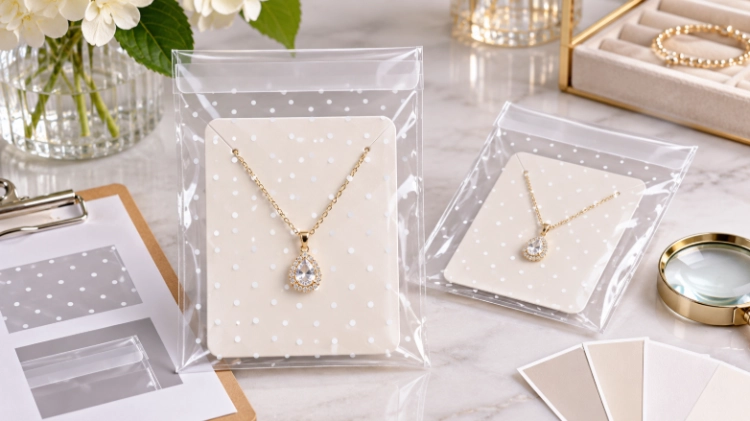
Establish the dimensions of the sale unit
The hypothetical 6 × 8 cm card may carry a hanging tab and a folded care slip; the pendant itself can push the film forward. Before ordering samples, assemble it exactly as the shop will sell it and take a side photograph as well as a front one. That side view explains to Hualei what must pass through the bag mouth far better than a pair of card dimensions alone.
- Dielineis the printer’s map of the finished bag edges, seals and flap.
- Clear windowis the unprinted film reserved for the jewelry and essential sales information.
- Quiet zoneis the blank area around a barcode that its scanner needs to identify the symbol.
Hualei makes a polka dot OPP bag from BOPP film for small jewelry and gifts. Its adhesive flap can be paired with customer logo or pattern printing; six size options span 3 × 4 + 2 cm to 12 × 15 + 3 cm. For this pendant, ask Hualei to mark the 7 × 9 + 3 cm option on a bag drawing. The final figure should be identified before anyone treats it as space available for the card.
I would request adjacent candidate sizes for a card near the catalog boundary. One sample may technically accept the card, but only if the packer eases a corner past the mouth; after a hundred units that becomes a costly irritation. The next size might load freely yet leave the jewelry sitting well below the printed window. Neither observation appears in a flat dimension chart. Keep the size that packs consistently and frames the piece well, even if that is not the smallest nominal fit.
For example, a stiff card that slides into the 7 × 9 + 3 cm option only when angled should be tested in the next Hualei format as well. The printed window may need to move on that larger sample; a size decision and an artwork decision cannot be approved independently.
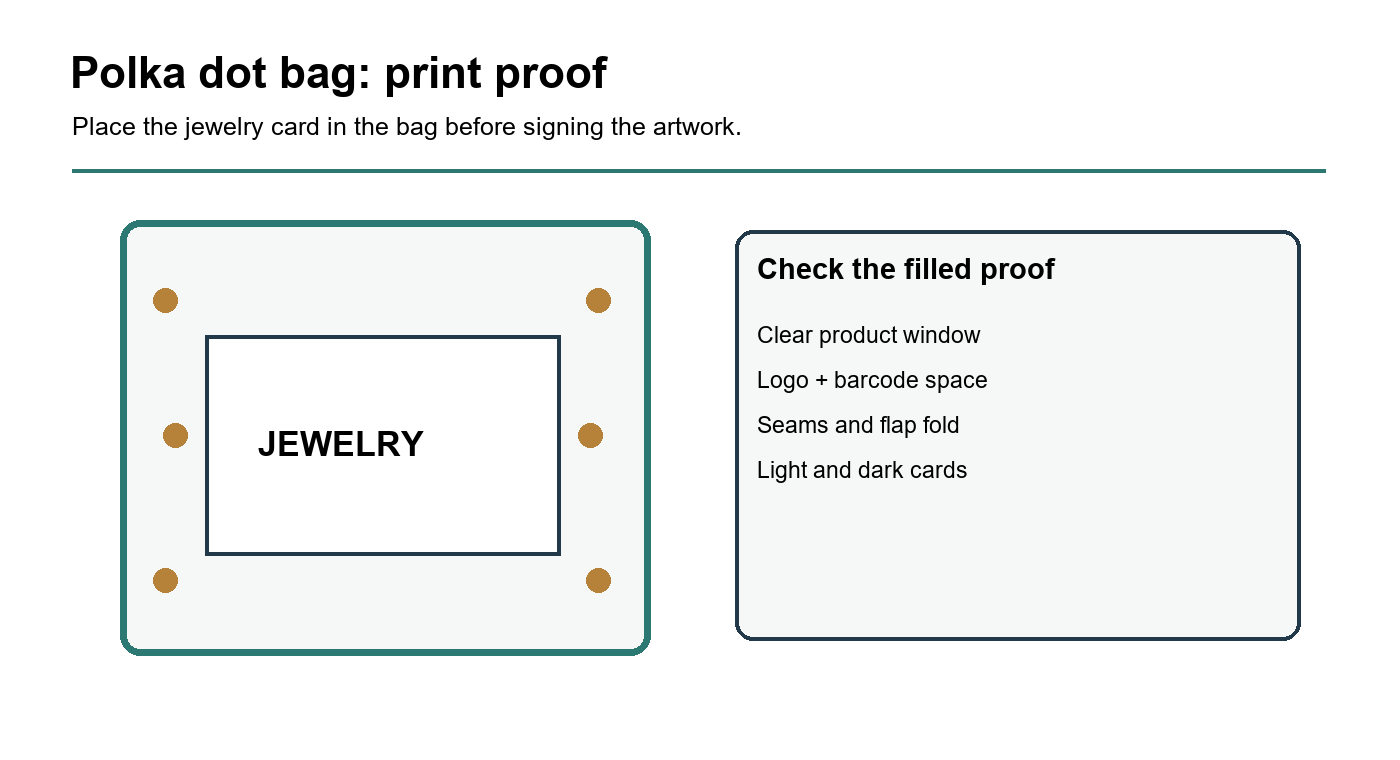
Figure: The print proof is judged around a filled card, with the product and label visible through clear film.
Compare film on the actual card
Hualei offers eight film thicknesses from 17 to 53 microns. Rather than assign a micron value to “jewelry,” compare a couple of plausible finished bags around the same card. A thin sample may show a stress point beside a corner; a stiffer one may form a pronounced flap crease. Reopen each sample as the shop would. Adhesive pickup on the card or a bag that will not sit neatly after opening is relevant if staff expect to show the item before sale.
The six listed Hualei sizes are 3 × 4 + 2, 4 × 4 + 2, 6 × 7 + 2, 7 × 9 + 3, 8 × 10 + 3 and 12 × 15 + 3 cm. The smallest formats are offered for little jewelry or trinkets; the larger ones can hold compact gifts and accessories. A card with a folded insert may need the next format even if the jewelry itself is tiny. Hualei also lists small cosmetics and stationery among possible uses. Those are separate trial packs, since a tube, pen or card pushes against the film in a different place.
The dot color and style can be changed, and a customer logo or design can be printed on the BOPP bag. Decide whether the dots are the main decoration or a border around the product before sending artwork. Hualei offers the self-adhesive version for quick closing in retail and gift packing; a display trial still has to show whether that closure works for the shop’s handling routine. For a wholesale order, identify each size, dot treatment and logo revision separately on the request. A quote for “polka dot bags” leaves those production choices unresolved.
A sleeve is a presentation component; transit protection and chain control may require an insert or outer box. Those parts have to be located in the size drawing, because “packed jewelry” could mean a card alone to one supplier and a card plus protective insert to another. The quote cannot be compared until the contents of the bag are fixed.
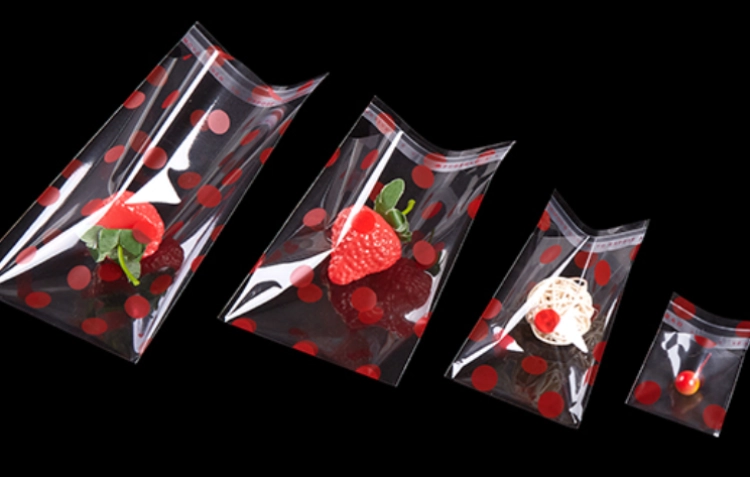
Put the product window on the dieline first
I would draw the clear product window on a transparent overlay laid over the plain filled bag. The jewelry and price need space, but so do the side seam and the portion of the back covered by the closed flap. A display tray may hide the bottom edge. Once those areas are marked, the dot pattern has a defined field instead of the entire rectangular PDF. If the logo crowds the pendant in that field, the pattern should give way.
Protect the barcode from folds and graphics
On the hypothetical pendant pack, the barcode could sit on the card beneath clear film or be printed on the sleeve itself. The distinction changes the proof, but neither version should bend across a seam or disappear under the flap. GS1’s placement guidance covers those obstacles and the blank quiet zone around a symbol. Reserve the code’s position on the drawing, then scan a closed, filled sample at the counter. A failed scan at that stage is an artwork decision; after printing it becomes wasted packaging.
For example, a barcode may be perfectly legible on a white jewelry card until dark dots on the clear sleeve sit in front of it. GS1’s quality checklist covers contrast and damage among common scanning faults. Try the shop’s scanner on the sealed pack; scanning an uncovered card leaves out the very print being approved.
Give the printer a reproducible artwork file
Ask Hualei for the selected format’s dieline and safe-area guidance before finishing the dot field. The file should make the top, reverse and adhesive flap unmistakable to someone who has never seen the jewelry card. Near a seal, a printed circle can be cropped into an odd fragment if the film shifts during converting. Keeping the pattern and logo as editable vectors makes that particular correction straightforward after the first print proof; a flattened low-resolution image makes it harder.
Test the printed bag in the display
The counter trial needs more than a single pristine proof. Have several bags packed in the ordinary sequence and placed together in the display tray; later, separate them and inspect the reverse. Ink rub near a lower seam, a curling flap or a logo bent around a card corner are different findings, each with a different possible correction. Photograph the fault where it occurs. A complaint labeled only “poor print” discards the evidence the supplier needs.
Keep a front and back photograph with an empty bag, filled bag and signed print proof. The record should state card version, bag format, film selection and artwork revision. Someone reordering the pack months later can then identify what was approved without guessing from a product-page image.
| Proof item | Reason for retaining it |
| Filled card in the printed sleeve | Shows actual dot position, clear product view and flap fold. |
| Scanned barcode and price label | Confirms that sales information works after packing. |
| Dieline and signed artwork revision | Ties the approved image to the selected Hualei bag format. |
For a busy jewelry card, a simpler bag from Hualei’s OPP bag range may show the item better. Make that choice from a filled display sample. Send card dimensions, packed photographs, preferred size and film, quantity and the artwork file through Hualei’s contact page, then request a printed physical sample. The bag and its artwork need a joint approval because the buyer will never sell them separately.
A buyer can review Hualei’s factory background on its About Us page. In a U.S. store, a card may name a stone or metal under the FTC Jewelry Guides. Keep that wording visible through the dots; for sales elsewhere, check the destination’s own jewelry-label rules before approving the printed sleeve.