
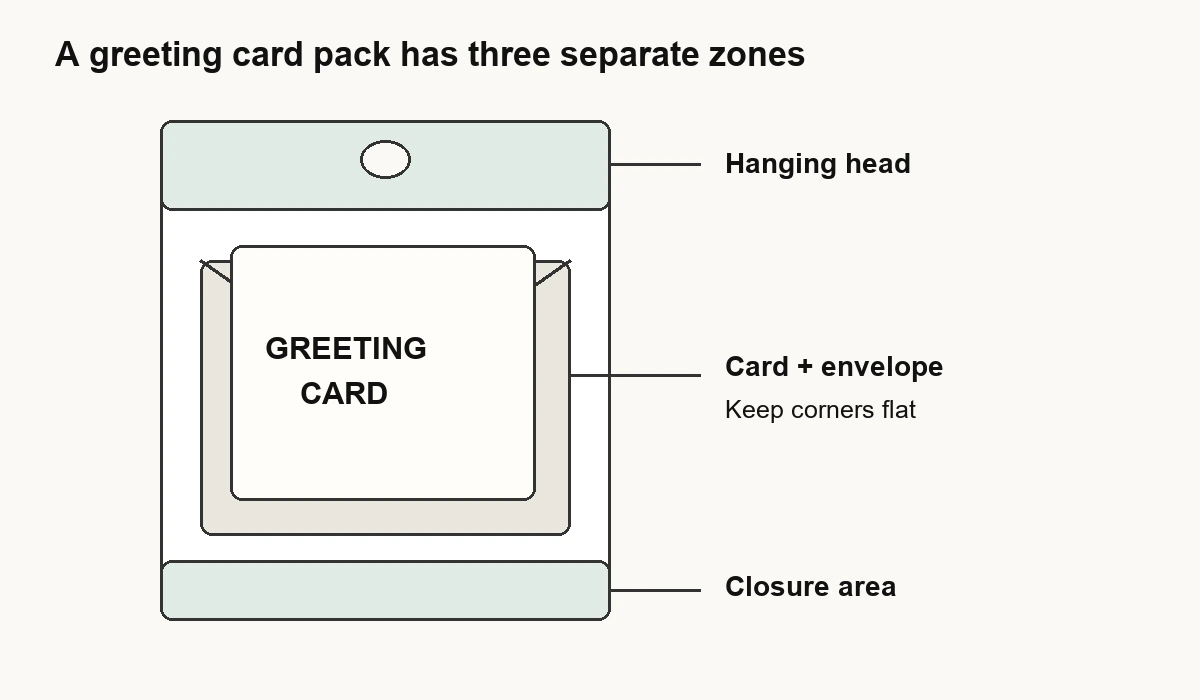
An envelope corner sticking out behind a birthday card is easy to miss on a packing table. On a shop peg, it’s much harder to hide. Turn a sample over before buying greeting card packaging. The front may look fine while the envelope behind it has been pushed round a corner during loading.
The card dimensions alone don’t tell you much about that problem. There may be a thick fold, a bow or an information slip in the bag as well. Before ordering, make up the pack exactly as it will be sold, with all those pieces included. Then take it apart, paying attention to anything that catches. An envelope that went in without trouble may still be difficult to remove.
Key Takeaways
- A card-only sample leaves the envelope fit untested.
- The adhesive needs a clear path past the paper when opened.
- Staff should be able to read the design code through a closed pack.
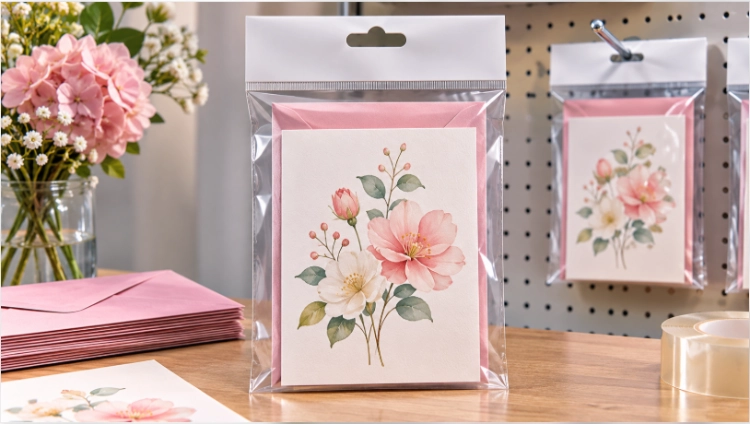
Build the paper stack before choosing a sleeve
For this job, a finished card is worth more than a printout of the artwork. If the actual print run isn’t ready, a sample made with the intended paper and finish is a reasonable substitute, provided it has the same fold. Put the envelope behind it and include the price card, if there is one. Otherwise, the sample understates what the packer has to get into the sleeve.
Decoration complicates an otherwise flat pack. With a bow glued onto the card, for example, the outside of the bow becomes part of the packed dimensions even though it wasn’t part of the printed rectangle. Taking the measurement with the bow pressed flat would give a misleading answer. The trial sleeve has to accommodate the decoration as the customer should receive it. A fit that relies on squashing it isn’t acceptable.
Keep the envelope square
Sometimes the envelope, rather than the card, sets the necessary width. A corner can curl round the card as the papers slide in, particularly if it isn’t supported by the rest of the stack. You won’t necessarily see that from the front.
The envelope flap is worth turning over before changing the bag width. Sometimes that is all the adjustment needed. Whichever arrangement loads cleanly should appear in a photograph at the packing bench, because dimensions don’t tell a packer which way round to put an envelope.
Decide what the customer should see
There’s little point in printing a greeting that an insert then covers. Supporting inserts can go behind the card, but a loose slip tucked there during packing may move once the sleeve hangs vertically. Check its resting position. Don’t carry over a portrait layout without trying it with a landscape design; rotating the contents changes which edge bears their weight.
Use the hanging format for a defined retail job
Hualei offers an OPP card head bag for hanging retail goods. Its physical layout and available options are useful starting points for a greeting-card request:
| Part of the order | Card-head bag option |
| Film and appearance | Transparent OPP or BOPP film, with the contents visible through the bag body |
| Hanging arrangement | A hole at the top for retail pegs, hooks or display racks |
| Closing arrangement | A self-adhesive closure at the bottom of the bag |
| Dimensions | Custom sizes, without a fixed greeting-card format |
| Film thickness | Eight choices: 17, 22, 25, 30, 35, 40, 45 or 53 microns |
| Customer logos, designs and brand messages printed directly on the bag | |
| Applications and quantity | Small gifts, accessories and retail goods; minimum order quantity 20,000 bags |
| Supply | Bulk orders for wholesale and retail businesses; Africa, South America and the Middle East are target markets for the card-head line |
A total quantity is not yet a complete order for a mixed collection. Send the number needed for each design and settle that split with the supplier. The same applies to display arrangements: will every pack hang, or will some go into a basket at the till? A miniature gift tag sold from a counter basket may call for a different bag entirely.
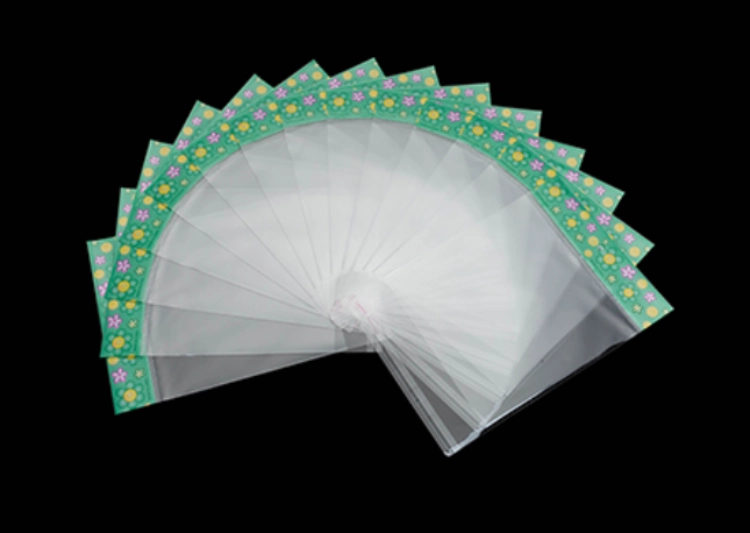
The smaller polka dot OPP bags use BOPP film and a self-adhesive closure. Their dot colors and styles are customizable. Size choices in centimetres are 3 × 4 + 2, 4 × 4 + 2, 6 × 7 + 2, 7 × 9 + 3, 8 × 10 + 3 and 12 × 15 + 3. These are bags for small gifts, jewelry, cosmetics and stationery. They are worth considering for a miniature tag after a fit check, but they don’t supply the hanging head needed for the peg display. A full card and envelope still need their own sample.
The dot-printed range also accepts customer logos and designs, so a publisher can discuss its own artwork instead of choosing only a dot color. Film options for these small bags are 17, 22, 25, 30, 35, 40, 45 and 53 microns. They are offered at wholesale and factory-direct prices for bulk orders. A mixed request should identify which packs use this format and which need the card head; the options belong to separate products.
Keep adhesive away from paper
Leave the liner attached until the papers are inside and straight. Peel it only when the contents are clear of the closing path. Then try opening the pack. Does the flap brush the paper on its way out? If so, change the loading depth or closure arrangement. Repeated opening needs separate confirmation for the selected bag.
A short bench record can keep these checks consistent:
| Inspection point | Acceptable sample condition |
| Envelope corners | Flat after insertion and removal |
| Folded spine | No forced compression or visible buckle |
| Adhesive path | Clear of all paper during closing |
| Front greeting | Readable in the hanging position |
| Rear label | Visible without opening the sleeve |
A heavier film won’t fix a corner pointed into the wrong place. Sort out the paper arrangement before comparing thicknesses, using the same card and handling sequence for each sample.
Give each design a dependable refill identity
The code needs to remain readable after the filled pack has been handled. An envelope can turn; a flap can cover a label. Check both.
For a hypothetical birthday range with different envelope colors, give each card-and-envelope combination its own packing reference. Carry that reference onto the carton contents record. For assortments, compare the actual designs with the intended set as well as counting them: a duplicate can hide a missing design while leaving the total correct.
Approve an ordinary handling sample
Handle the filled sample on its intended fixture, then photograph both sides. Look for a moved insert or a caught envelope.
Keep the approved pack with instructions naming the card, envelope, stack order and closure position. An envelope change needs another fit check.
Archival claims need evidence about the actual enclosure, beyond a successful retail packing trial. The Library of Congress’s guidance for documents and manuscripts includes supportive enclosures and flat storage among its preservation recommendations. A card looking tidy inside a clear bag doesn’t demonstrate those wider storage requirements have been met.
Questions before ordering greeting card bags
Can one sleeve cover several card designs
Yes, when the finished stacks fit alike. Include the largest envelope and the thickest decoration in the trial. Keeping one unusually bulky card in a separate format may be more sensible than making every pack larger.
Does the hanging head replace a backing card
No. The head holds the bag on the fixture; a backing card supports the papers or carries information. Try the finished pack before deciding whether that extra insert is needed.
What should accompany a sample request
A parcel containing the finished card, envelope and insert gives the supplier something concrete to fit. Include a display photograph, quantities per design and the intended front view. Custom dimensions and printing can be discussed through the Hualei contact page. Leave final approval open until the complete packed sample has been checked.
For the card-head bags, the typical delivery period is 10–15 business days, depending on order volume and customization. Hualei packs these bags for protection during transit. Neither point replaces a schedule for your order: confirm what the quoted period covers, the dispatch date and the expected arrival before fixing a shop launch.