
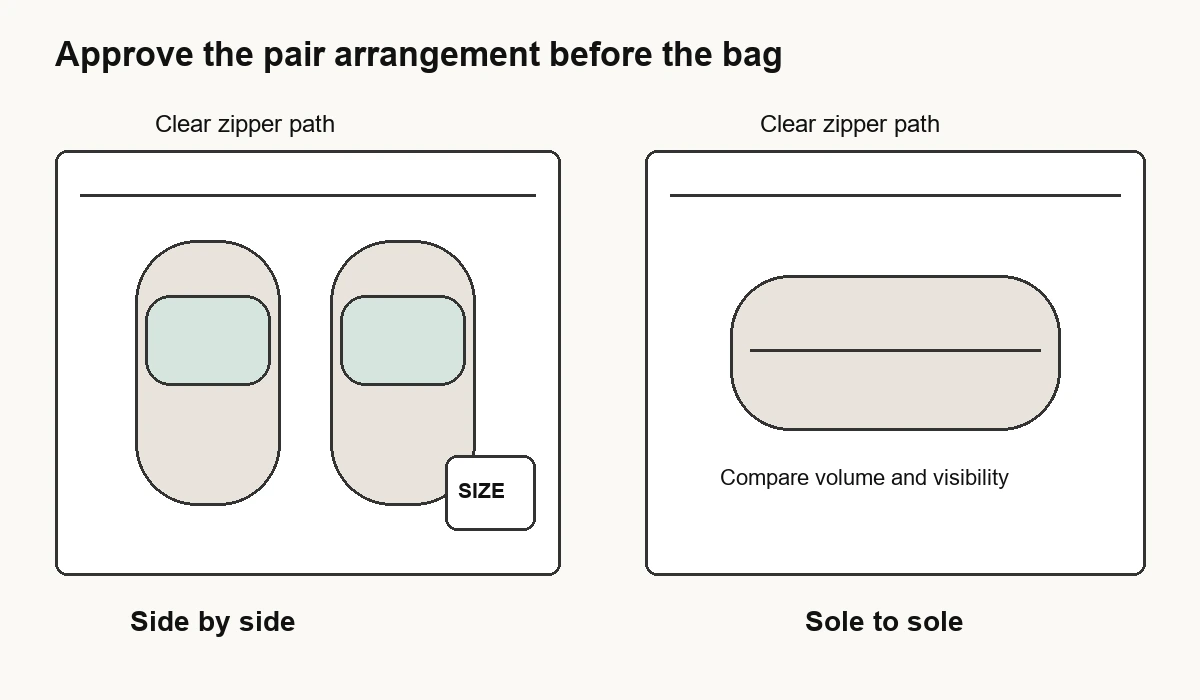
Put a pair on the bench before requesting zipper bags for slippers. How should the shop receive it: side by side, or with the soles together? Send the supplier that arrangement, preferably as a physical pair. Photographs from the front and side help if sending a pair isn’t practical. Don’t accept a sample that needs you to squash both uppers to get it closed.
A thin hotel slipper has little in common with a plush winter pair of the same shoe size. The side view matters as much as the size chart when describing the pack.
Key Takeaways
- Use the arranged pair for measurements; the shoe-size chart leaves out too much.
- Find somewhere for the tag before it becomes an obstruction at closing.
- One bag size is convenient only if both ends of the slipper size run behave well in it.
Decide where the soles belong
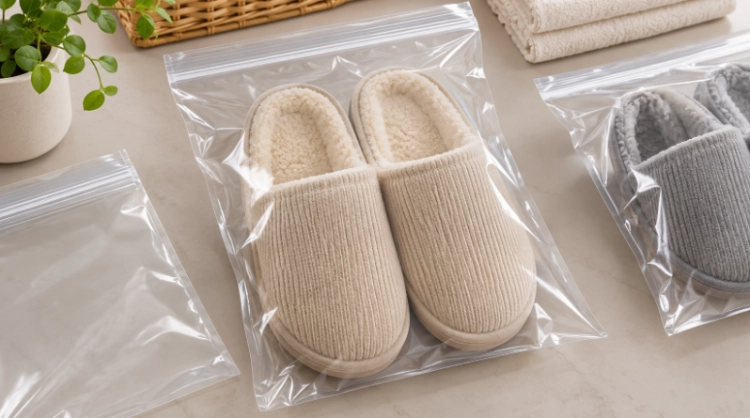
An embroidered slipper makes the choice fairly easy to explain. Side by side, the pair shows more embroidery; sole to sole, it may form a smaller bundle. Neither arrangement settles the question by itself. Put both photographs in front of the buyer and agree which view belongs on the shelf before selecting a bag around it.
A stiff sole shouldn’t have to bend to enter the chosen bag. Even where temporary compression is acceptable, take the slippers out again and see how they recover. That matters if the shop expects to display them flat. A smaller parcel isn’t much of a saving if the product comes out looking misshapen.
Give soft uppers time to settle
A hand around the sample is extra compression the package won’t have in storage. Put it down before judging the fit. Leave it for an agreed period, then try opening it again. Fabric caught beside the zipper is a problem to fix. So is an upper that comes out looking different from the approved unpacked pair; recovery needs judging for the actual material.
Put accessories in a fixed place
The care insert needs a home too. Between the soles keeps it out of view; behind the pair may let the shop read it without opening the bag. Try both during packing. An insert that repeatedly slides up to the zipper will annoy the packer long before the order is finished, so settle its position with the sample.
Match the zipper format to the finished pair
Slippers and shoes are among the uses for Hualei‘s transparent plastic zipper lock bags, alongside clothing. Their zipper opens and reseals; the clear film lets staff see the pair without opening it. Custom printing is available for a customer logo or design. There is also a warning-print option for safety or care wording. Agree that wording for the intended market before artwork approval; the availability of printing doesn’t settle what a particular pack must say.
There are seventeen sizes in the Zipper bag01 range. At the smaller end, the choices are 14 × 20, 18 × 25, 20 × 25, 20 × 30 and 25 × 30 cm. Between these and the largest bags are 25 × 35, 25 × 37, 28 × 38, 30 × 35, 30 × 40, 32 × 44 and 35 × 45 cm. The remaining sizes are 40 × 50, 40 × 60, 45 × 60, 45 × 65 and 50 × 60 cm.
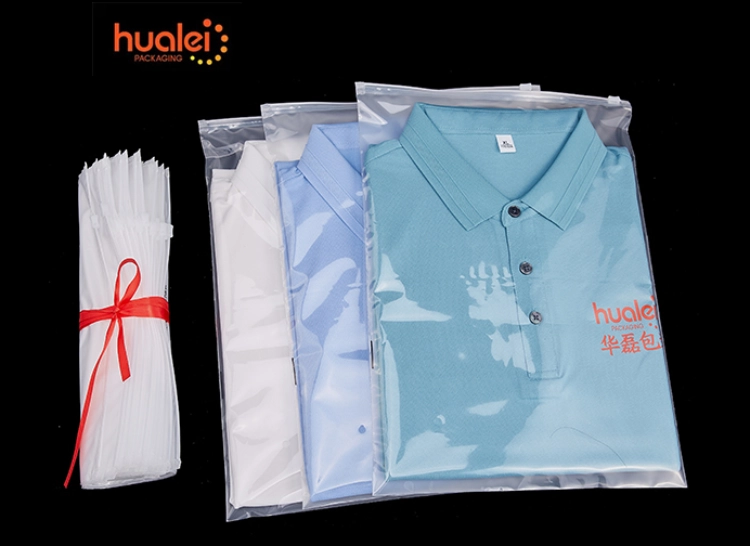
The thickness choice starts at 50 microns and rises in 5-micron steps to 90: 50, 55, 60, 65, 70, 75, 80, 85 and 90 microns. Minimum quantity is 20,000 pieces. T-shirts, jeans, underwear and other apparel are further uses for this wholesale, retail and e-commerce range. If your enquiry divides the order between different prints and sizes, get that split priced explicitly. The minimum alone doesn’t tell you how such an order will be treated.
If the pack doesn’t need repeated access, compare the OPP clothing bag. This transparent BOPP range includes self-adhesive options and accepts customer logo and design printing. It covers slippers as well as garments. Eight sizes span 18 × 30 + 4 to 40 × 60 + 4 cm, with film choices from 17 to 53 microns. The intermediate sizes are 22 × 32 + 4, 25 × 36 + 4, 28 × 41 + 4, 30 × 44 + 4, 32 × 46 + 4 and 35 × 46 + 4 cm. Between the thinnest and thickest films, the choices are 22, 25, 30, 35, 40 and 45 microns. These give a supplier concrete alternatives to sample when a zipper isn’t needed.
For Zipper bag01, typical delivery is 10–15 business days, depending on order size and customization. Bulk orders ship directly from the factory. Confirm the current schedule against the required date; the packing trial and artwork approval need their own allowance before production is released.
Measure the pair without compressing it
Consider a hypothetical 28 cm-long pair and a bag quoted as 30 cm high. Those numbers look compatible until you ask where the zipper starts and how much space the slippers’ depth takes up. Get a sample rather than approving that fit on paper. While measuring the pair, keep the ruler beside the upper so it doesn’t flatten the fabric.
For example, suppose the heels sit easily at the bottom but the toes reach into the zipper. That is a different fault from a pair that won’t pass through the mouth. Photograph the tight point before asking for a larger bag. Otherwise the next sample may gain width when length was the problem.
At the other end of the size run, look for a pair that turns around inside the spare space. Can staff still see its size? An insert or a different label position may allow a shared bag, but count the extra handling involved. A second bag size may be the simpler answer.
Make the size visible before opening
Choose a label position on the filled sample, then stand or lay it as the shop intends. Does the size still face the person reading it? If not, move the label and try again. Changing that small detail may be enough to keep an otherwise workable bag.
Take a hypothetical carton of gray slippers in three sizes. Color won’t help anyone sort that carton. The closed packs need readable size codes. Before closing them, check the left and right slipper against the code as well: a correct bag label can sit quite happily over a wrongly matched pair.
For barcoded goods, keep a filled sample for a scan check on the intended equipment. Take it through the same motions as a pack at receiving or checkout, including turning it to find the label. GS1’s barcode guidance explains how standardized barcodes carry product identification. Check the final pack as well as the artwork.
Run a small packing trial with a clear failure record
Hand the samples to the people who will pack the order, with the proposed instructions. Can they reproduce the approved pack without being shown a special trick? A sample assembled slowly by one person may hide an inconvenient loading step. Note which bag and film accompany each size so any change can be traced afterwards.
| Observed problem | First item to investigate |
| Fabric caught in zipper | Loading depth and closure clearance |
| Upper visibly flattened | Pair orientation and available volume |
| Size label turned inward | Label location and spare room |
| Seam pulled during loading | Opening width and loading method |
| Wrong left and right pair | Pair check before bag closure |
“Bag too small” leaves the supplier a lot to guess. A photograph with an arrow at the trapped toe is more useful, accompanied by the exact bag size used. Don’t throw out that sample when another arrives. Having both on the bench makes it easier to judge the correction than relying on memory or two separate email threads.
The outer shipping pack still needs attention. A zipper closed around a pair doesn’t establish waterproof performance, and a retail film bag doesn’t replace carton protection. Put any special transport requirement into the enquiry separately.
Questions that affect the order
Can the same bag fit every slipper size
Only after the smallest and largest packed pairs pass the same checks. A size that accepts the largest pair may leave smaller pairs free to rotate. Shared packaging should make sorting and packing easier as well as reduce the number of bag sizes.
Is a thicker bag always easier to close
No. Zipper clearance and pair volume still govern closure. Compare thicknesses after the fit is settled, keeping the slippers and packing method unchanged.
Send the approved pair arrangement and the required order split through the Hualei contact page. Keep a filled reference sample with the final dimensions and artwork so the next order reproduces the same pack.