
An OPP clothing bags manufacturer will help you confirm the finished garments size, film thickness, closures, print areas, and folding carton specification prior to production. The correct specification for the finished garment is one that allows a small amount of working clearance and protects the garment throughout the handling process. The finished garment should also look neat and stack well on retail shelves and in online packaging.
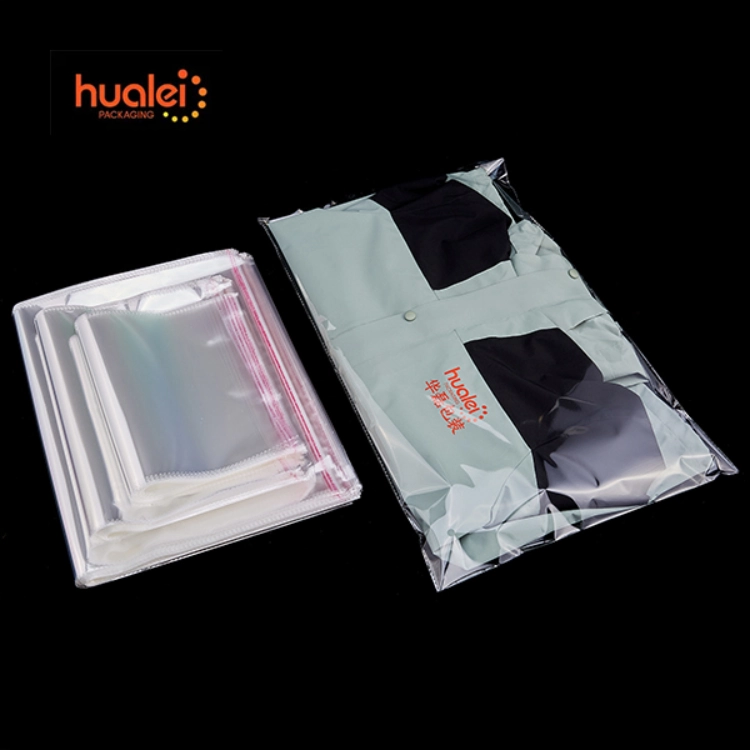
Hualei lists clear OPP clothing bags in sizes from 18 x 30 + 4 cm to 40 x 60 + 4 cm, with film options from 17 to 53 microns. The bags can use a self-adhesive strip and can be printed with a customer logo or design. Use those ranges as a starting point, then approve a filled sample for each important garment SKU.
Quick checklist for a clothing bag quotation
- Please send us dimensions of folded items: length, width, thickness, dimensions of any inserts or hangtags.
- Choose a finished bag size which allows for garment insertion and does not allow garment to slide.
- 17 to 25 micron film to lighter packs, 30 to 53 microns film to heavier or rougher packs for review.
- Check if the +4 cm feature refers to the flap or another finished dimension on the supplier’s drawing.
- Mark adhesive flap, seal edges, barcode and clear viewing window on artwork.
- Request a physical sample prior to approving a bulk shipment for testing.
How to choose the finished bag size
Measure the folded garment
Measure the product after the same folding method your packers will use. A single T-shirt, a pair of jeans, slippers, and underwear do not create the same pack thickness. If a cardboard insert, size sticker, or warning card goes inside, include it in the measurement.
The available dimensions for Halei’s bags are: 18 x 30 + 4 cm, 22 x 32 + 4 cm, 25 x 36 + 4 cm, 28 x 41 + 4 cm, 30 x 44 + 4 cm, 32 x 46 + 4 cm, 35 x 46 + 4 cm and 40 x 60 + 4 cm. While these are useful reference points, they must not be used as a substitute for actual sampling. A bag that is only marginally too narrow for example can get caught on the shoulders or corners of a garment during insertion. A bag that is significantly too wide allows the garment to move about and does not provide a good visual presentation.
Treat the flap dimension as part of the fit
Define the +4 cm notation on the quotation and sample drawing. The notation +4 cm might refer to the flap or another end feature, so we need to clarify this with the factory. Open the bag flat and fold it up to show where the measurement is taken.
How to set film thickness
Light packs can start with a thinner film
Hualei also offers 17, 22 and 25 micron options in OPP clothing bags for lightweight garments such as T-shirts, underwear and quality goods that require careful packaging. The Transparent BOPP film allows garments to be seen through the bag, creating a clean and visible packaging solution.
Don’t choose the thinnest film just because your bag is big. The flaps, corners and seal area need to withstand filling, packing into cartons and subsequent distribution. Test the film in a filled bag, not just as a loose sheet of film.
Heavier garments need more support
The same product information is given for the 30, 35, 40, 45 and 53 microns thicknesses. These could be suitable for products made of denim, layered products, bulky products or for products that are to be packed into cartons and then moved around a lot. Although a greater thickness gives a product with a firmer hand, it does not compensate for incorrect sizes or for inadequate closures.
Ask the manufacturer to quote the exact thickness tolerance and to identify whether the finished bag uses the same film gauge across the body and flap. Keep the approved sample with the purchase order so a later repeat run has a clear reference.
When a self adhesive closure fits the packing line
Choose the closure around the packing motion
A self adhesive strip allows the operator to insert the garment, then remove the liner from the strip before folding the flap down to the garment. This allows packaging of many different SKUs by hand. It also creates a neat edge to the front of the garment for retail display and parcel packing.
Short packing trial. Test folded product through the packing process. Check for ability to remove liner without disturbing print. Check that flap closes neatly. Check that adhesive does not get on visible areas of garment.
Check storage and reopening
In warehouse storage of finished goods, the adhesive side of the liner should be protected from heat, from dust, and from pressure. In your retail process, inspect and re-pack through the opening flap. Test for tearing of film around the adhesive.
How to plan custom printing
Custom printing can display a logo, brand name, care note, size or collection message. The main viewing area of the custom printed garment should be clear of any print and space allowed for the adhesive flap, sealed edges, barcode and any labels that will be applied after printing and packing.
Provide send vector artwork when possible. Approve printed sample on actual transparent film. Ink printed on clear film can look very different than printed on white paper. Inspect for registration, fine print, contrast and how printed artwork looks after the flap is folded.
For background information on the material, please refer to the OPP film guide. For a related converted format, please refer to the OPP clothing bag product.
How to build a size and thickness matrix for several SKUs
Approving apparel one style at a time is not the same as approving an apparel program. Create a simple matrix listing all folded products with packed dimensions, desired bag size, film thickness, closure, print version number and order quantity. Two potential problems are exposed quickly: very similar products being packed in different bags; a single bag being stretched to include products that require different clearance.
A useful way to start is to group products by packed shape. Lightweight underwear and flat T-shirts may share a smaller format, while folded jeans need more width, thickness, and insertion clearance. Slippers create a different problem because their edges and uneven profile can press against the film. The group names are internal; the factory still needs the exact finished specification for every ordered bag.
Stack up the various samples within each group and pack one sample from each group. The smallest or lightest article in a group should not be the only sample tested. Pack in the thickest fold, the largest label and any cardboard inserts that will be used in production. Close up the flap on the bag and then stack up the filled bags as they would be stacked in a carton. Check that one size can be used for all articles in the group and that they are not too loose or putting undue stress on the side seals.
The test above also helps with controlling the inventory. If two products can be put in the same clear bag, then one of the product specifications can be removed from the packaging SKUs, if they cannot then a practical reason is given to keep them as separate products as opposed to a separate specification being added based on a spread sheet.
Sample approval points for repeatable production
Approved samples must contain more information than just what they look like. Record finished width and length, +4 cm dimension description, film gauge, adhesive position, flap orientation, print orientation and fit test product. Take photos of samples empty and filled and retain the actual samples against PO ref.
Check several actions during approval. The garment should enter without catching; the release liner should peel cleanly; the flap should land squarely; and the adhesive should not touch the garment during packing. Rub the printed area by hand and inspect small text and registration. After the filled packs spend time in the proposed carton, reopen them and look for stretched corners, seal stress, liner movement, or marks on the film.
Reorders of approved specifications require a detailed statement of changes made. Items such as a new logo, a different way of folding garments or new inserts can affect fit even when the nominal bag size remains the same. Such changes require review of a new filled sample before production can recommence.
What to confirm with an OPP clothing bags manufacturer
Request a quote that describes the finished bag
Please include size, thickness, any flap or gusset notation, type of closure, print colors, any artwork, quantity of each SKU, carton quantity requirements and desired delivery location. Hualei offers factory-direct wholesale packaging products with custom logo printing options. Current price, MOQ and lead time should be confirmed for the final specification.
Inspect a filled and printed sample
Examine the folded garment for proper Shoulder/Clearance, Flap Alignment, Adhesive Release, Print Position, Transparency, and Carton Fit. Sample approval for orders of multiple sizes should include a sample for each garment size type to ensure that the approved sample represents all sizes in the order.
Conclusion
When looking for the best OPP clothing bags manufacturer, convert the folded item into a finished product with set measurements. Using Hualei’s sample dimensions of 18 x 30 + 4 cm to 40 x 60 + 4 cm, select a gauge of 17 to 53 microns depending on your handling needs. Check that the self adhesive flap adheres to the bag when filled. This ensures that the manufacturer has clear targets to work to and your team can pack product consistently using the bag.
FAQ
What sizes can an OPP clothing bags manufacturer supply?
The supplied product information by Halei lists all available sizes from 18 x 30 + 4 cm up to 40 x 60 + 4 cm. Sizes above that can be produced as custom products after providing the needed product specifications.
What thickness is suitable for OPP clothing bags?
The specified range is 17 to 53 microns. For lighter weight articles 17 to 25 microns may be an initial starting point, whereas denim, bulky packs, inserts or articles that are subject to rough handling may require 30 to 53 microns. Sample a completed unit prior to production of bulk units.
Can clothing bags be printed with a brand logo?
This information describes custom logo and design printing. Please check the artwork on transparent film and especially the flap, seal edges, code area and viewing window before final approval.
Are self adhesive clothing bags suitable for wholesale packing?
These bags are suitable for hand-packing lines where quick sealing of the bag without the need for extra tape is required. Check the release of the liner, the alignment of the flap, storage conditions and the possibility of reopening the package with the garment inside.