
The pendant is not what the bag has to hold if it is sold on a display card. Nor is the gift alone the measured item when it goes out in a box and ribbon. Take the assembled retail pack as the unit. It has to enter through the mouth, sit on the opened base and show its intended front.
At a glance
I would send the factory two views: the complete retail pack on a shelf and the proposed bag lying flat. The first shows which side faces shoppers. The second marks front width, opened base, mouth and closure allowance. A filled sample settles the questions the flat drawing cannot.
Measure the Product in Its Selling Position
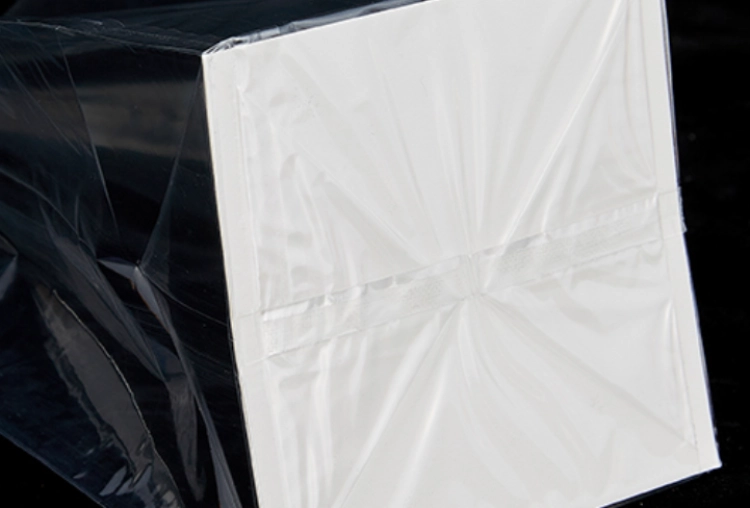
Square-bottom OPP bags are transparent polypropylene bags formed with a base that can stand on a counter or shelf. Their fit is controlled by the retail pack’s front face, depth and height, not just the dimensions of the item inside it.
Measure the packed item, not its catalogue dimensions
Use the packed item, with card, box, ribbon or insert already fitted. Measure across the face that shoppers will see, front to back at the deepest point, and from the shelf to the highest point. A wide jewelry card can set the width even when the pendant is small. Put that orientation on the drawing.
Turning a box sideways changes the front and the depth. An arrow on the photo is an easy way to say which side faces out. The same three numbers, without that arrow, can describe a different bag.
Hualei‘s square-bottom OPP bags are offered for gifts and other small or medium retail packs. The examples include necklaces, earrings, bracelets and rings, plus candy, biscuits, chocolates and other sweets. Do not size a carded earring and loose confectionery from one generic “small item” drawing; their loading shapes differ.
Check how the unit passes through the mouth
A full pack should go in without the corners being forced past the mouth. The base may be roomy but the opening may still stop a rigid gift box. For sweets, test a normal filled quantity. A few loose pieces make almost any sample look easy to load.
Write down where the first interference occurs: mouth, side fold, base or closure. A wider front face is not the remedy for a tight opening, and extra height will not help a box that cannot get inside. This note makes a sample correction much clearer than “bag too small.”
Turn the Measurements Into a Bag Drawing
Show the front panel and opened width separately
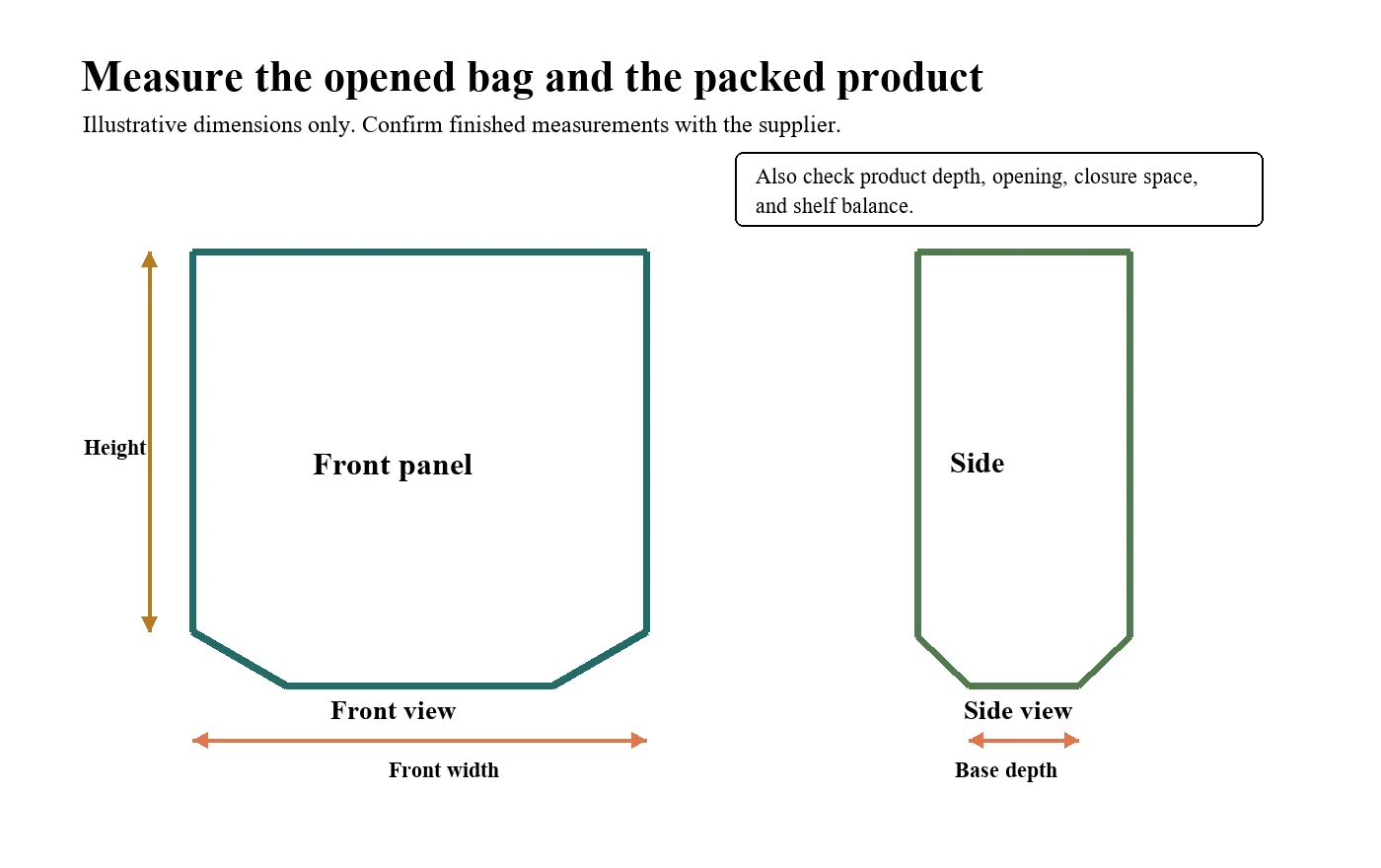
On the drawing, label the panel visible to the shopper after the base has been opened. Show the gusset and opened depth in a side view. If the factory’s width figure is for flat film, write “flat width” beside it. It cannot be assumed to be the usable front face of the formed bag.
Give product dimensions and bag dimensions different labels, with units and a height datum. Mark which side faces the shelf aisle. At sample review, check these three points separately:
- What is the usable front-panel width after opening the base?
- How deep is the formed base?
- How much closure clearance remains above the product?
| Drawing item | What to mark | Sample check |
| Retail unit | Outside width, depth, and height with cards or boxes included | Does the complete unit pass through the mouth? |
| Front panel | Visible width with the base opened | Does the product face forward without looking cramped? |
| Base | Gusset depth and fold lines | Does the filled pack sit upright on a shelf? |
| Top | Height above the product and planned closure | Can staff close it without crushing the contents? |
Front-panel width is what the shopper sees across the opened bag. Base depth comes from the gusset. Top clearance is the film remaining for the planned fold, sticker or other closure. Put a separate arrow beside each; a note saying “allow enough” cannot be checked on a sample.
The outside box or card measurements describe the load. The flat web number describes material before the bag is opened. Open the gusset and both the visible front and the usable inside depth change. Keep the two measurement sets in separate columns.
Leave space for the base and closure
Start the base sketch with the depth of the packed product. A hard box keeps its corners; a card can bend and loose sweets shift. Try a paper version of the base around each pack. That tells you more than adding a generic few millimeters to every dimension.
Height runs from the shelf surface to the highest point on the packed item. Above that, allow for the planned sticker, fold or seal. A box marked 80 × 45 × 120 mm is only the box; the open mouth and gusset also need room, and the front panel still needs to be specified.
Hualei offers custom bag size, thickness and design. “Gift size” is not an order dimension. Send the measurements in millimeters or centimeters with the retail sample or its marked photograph.
Try the Filled Bag on a Shelf
Open the base before checking stability
An empty square-bottom bag may stand nicely. Put the actual retail pack in, open the base fully and try it on a level shelf. The weight can settle to one side and change the result. That loaded view is the one the shopper will see.
If the filled bag leans, check where the item sits and whether the base is fully open. A thick gauge will not fix a top-heavy gift box. Lift the pack and put it down again; the folds should not collapse after one handling cycle.
Do the same shelf trial for each proposed size, with the top closed as it would be in store. A boxed necklace should go in without pressure, present its front and stand straight. Keep a photograph of that completed pack with the sample number.
Test the smallest and largest packs
If a bag must serve several SKUs, try both ends of the range. The small pack may appear buried in spare film, while the largest box may catch at the mouth. In that case separate sizes can be easier for packing staff and better for the shelf display.
Look at the filled bag at shelf height, not only through the flat film. A necklace card can turn, sink or hide part of the jewelry even though the OPP itself is clear. Use that view to place the print.
Select Film Thickness and Plan the Print
Compare thickness on the actual pack
Hualei offers 25, 30, 35 and 40 microns. Write the selected thickness on the approved sample and quote. Gauge does not answer whether the base stands with this box or whether a sharp corner catches as the bag is filled.
The corners of a box and the bottom folds put the film under local stress. ASTM D882 can compare tensile properties of thin plastic sheeting in a controlled test. I would keep its result apart from the shelf trial, which checks balance of the whole filled pack.
Where bags cling in a stack, ask the converter about surface friction and ASTM D1894-24. That method compares static and kinetic friction of plastic film and sheeting. It cannot show the loading of this particular gift box, so the filled sample remains the practical check.
The product description says these bags help protect contents against dust and moisture. Ask for relevant material or finished-pack information if storage or transit conditions make that claim important. Do not write an unmeasured barrier value into the buying specification.
Approve artwork after the base is formed
A logo, brand name, message or decorative design may be printed, including birthday and holiday versions. Approve the art on a filled bag. Forming the base changes which area is visible; a logo centered on a flat proof can end up near a fold.
Show the front panel, base folds, print area and top closure on the art file. The square-bottom OPP bag product page describes options; the approved order drawing should state the size and artwork version actually bought.
Confirm Food-Contact Use Before Ordering
A listed biscuit or candy use does not settle whether food may touch the bag directly. A buyer can have wrapped sweets, or unwrapped sweets against the film; those are different requests. Tell the supplier which one is intended, and how the pack will be stored and handled.
For the U.S. market, 21 CFR 177.1520 concerns olefin polymers under stated conditions, not approval of every constructed OPP bag. In the EU, Regulation (EU) No 10/2011 covers plastic food-contact materials within the wider Regulation (EC) No 1935/2004 framework. Match any documents to this bag, its contents, use conditions and destination before deciding on direct contact.
Plan the Order Around the Approved Size
The stated starting point for a custom run is 10,000 bags. Hualei should confirm the minimum on the chosen size and print, since setup may change the practical order. Put that figure with the approved sample record.
The ordinary 10–15 business day production estimate varies with quantity and customization. Get a date for this order, then work back from the shop launch with transit included. Hualei sells to Europe and North America; the destination country belongs on the quote.
The order record should carry the approved dimensions, micron gauge, art revision, sample date and delivery terms together. Without those, a changed price may be a changed bag rather than a changed rate.
Questions Buyers Ask About Bag Sizing
How much larger should the bag be than the product?
Size the complete unit with a filled sample. Where does it first touch the film? A narrow mouth, shallow gusset and undersized front panel need different corrections. There is no allowance in millimeters that answers every one of them.
Can one bag size cover several products?
Yes, when the largest and smallest finished packs both load cleanly and present well. If the large one presses the opening and the small one is lost in slack film, make separate sizes. Staff then have a clear SKU for each pack.
Is an OPP bag for biscuits automatically suitable for direct food contact?
No. Decide whether the biscuit actually touches the bag. For direct contact, check the finished-bag and material documents for that food, use and destination before an order is released.
Request a Sample Against the Final Pack
Hualei’s About Us page gives supplier background. Send the bag inquiry with the filled retail unit’s width, depth and height, its front-facing side and the closure. A photo or physical pack can explain awkward shapes. Have the quote state the bag dimensions, and sign off a filled sample before artwork printing or a 10,000-bag run.