
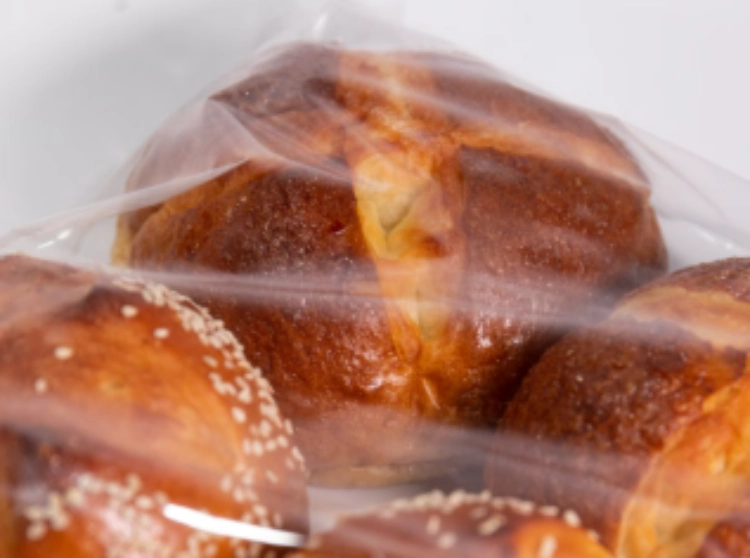
The sample bag arrives flat and spotless. A loaf still releasing moisture can cloud it; a boule can draw the flap taut; a seeded crust can leave crumbs exactly where the adhesive needs to land. Try the bag during normal packing and keep the filled result on the sales counter.
At a glance: a bread bag passes only after a loaf has been loaded, displayed through its normal sale period, and matched with food-contact evidence for the exact finished construction.
Define the display job before choosing the bag
Hualei offers self-adhesive OPP bread bags made with BOPP film and optional printed artwork. Its size notation reads 23 × 50 + 4 cm or 25 × 35 + 4 cm. Before comparing a loaf to either format, mark the body and the added allowance on the sample drawing. The buyer needs to know where bread space ends and flap space starts.
The film has a display job. Shelf-life claims belong to the bakery’s product and process evidence. Before requesting a sample, record the intended display period and the bakery’s normal cooling practice. Without these conditions, a “no fog” observation has no clearly defined testing timeframe.
- Bag bodyis the space that holds the loaf, excluding the closure flap.
- Flap allowanceis the extra film that folds over to meet the adhesive strip.
- Contact conditionsare the food, temperature and duration covered by the finished-bag evidence.
Size the loaf as it will be sold
Check loading and closing
The bag mouth is where many close fits fail. Have the regular packer load several loaves, not just one showpiece. A rough crust catching the edge may knock seeds into the adhesive; a narrow mouth may make the worker compress the loaf. The ruler cannot overrule that result. A bakery bag should allow the bread to keep its sale shape.
The adhesive strip needs a clean landing area. Crumbs on the strip can lift a corner, but so can a flap stretched over the top of an oversized loaf. These are different faults. If the strip stays clean and still will not reach, adjust the size. If the strip is dirty, review the packing motion and closure position. There is little value in asking for a “stronger adhesive” before knowing which fault you have.
Put the label on the filled sample. Does it crease at a seam or cover the crust that makes the loaf appealing? A custom-printed panel needs the same check. It may sit perfectly on a flat proof yet wrap around the loaf’s side once filled. Mark the clear product window with the bread inside.
Run a cooling and condensation trial
The American Society of Baking explains that heat and moisture leave bread during cooling and vapor can condense on a cooler wrapper surface. This is why a film sample held in a warm office says little about the bakery’s packed loaf. Run the filled-bag trial on a normal production day to reflect actual bakery conditions. If staff pack bread at different cooling points, label samples from each point and evaluate them separately.
For example, two packs made from the same batch can be closed at the bakery’s earlier and later normal cooling points, with both times recorded. Compare them at the same display hour. A visible difference then gives the baker a process question to investigate before blaming the clear film.
Watch the pack over its real display period
Mist does not automatically mean the film is defective. First compare packs closed at the bakery’s different normal cooling points. If extra cooling clears the wrapper but the shop cannot wait that long, then discuss a different construction with the supplier. Avoid putting “breathable” or “anti-fog” on a purchase order for a standard clear bag unless the exact quoted version has that property. A vented or modified pack is a new product to test and document.
Verify the intended food-contact use
Bread in direct contact with the film changes the documentation question. “BOPP” tells you the material family, but the finished bag also has a closure and may carry print. The U.S. FDA describes those component issues and separates food types from conditions of use. Ask for evidence matching the quoted bag, bread type, contact period and temperature. If the destination is elsewhere, use that market’s requirements instead of treating a U.S. page as a universal certificate.
Mark the contact side on the filled-bag drawing. Show ink, adhesive and any insert. The bakery’s food-safety lead and the supplier can then review the same construction. A document for bare resin or a different unprinted bag should not be silently attached to this job. File the matching evidence with the sample and artwork revision, where it can be found at reorder time.
Compare Hualei’s bread-bag options on a real sample
Hualei offers this bread bag in eight film thicknesses, from 17 to 53 microns. Request a small comparison set rather than assuming that the thickest film will suit every crusty loaf. Test each shortlisted thickness under the same loading, closure, and counter-display conditions.
The bakery can close Hualei’s transparent BOPP bread bag with its built-in adhesive strip, without installing a heat sealer for that step. Hualei also offers printed designs for bags used with rolls, biscuits and small confectionery products. Those items would need their own filled-pack fit decisions; a bread format is not a universal pastry format. Request the specific film, artwork and direct-contact evidence together when buying wholesale quantities.
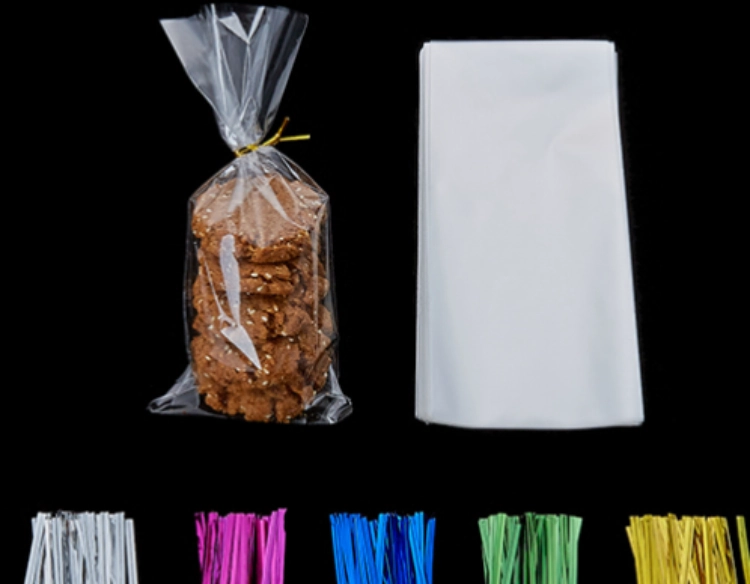
Hualei’s listed formats are 23 × 50 + 4 cm and 25 × 35 + 4 cm, with eight film selections: 17, 22, 25, 30, 35, 40, 45 and 53 microns. The extra 4 cm appears in both size descriptions; confirm on the drawing how that allowance is measured before ordering. The range is offered for loaves and rolls as well as biscuits, cookies, candies and pastries. Put a baguette and a round loaf beside the two samples first; reserve any confectionery use for a separate fit and food-contact review.
For example, the long format may suit one loaf while leaving another with a loose, poorly placed flap. Check both filled samples.
For a printed Hualei order, send the logo or artwork with the selected bag size, film option and intended direct-contact use. The clear construction is meant to show the food, so mark the area the print must leave open on a filled sample. Hualei offers wholesale quantities and custom artwork, but neither a clear appearance nor a printed product name supplies food-contact evidence. Request documents for the finished version that will be bought, including its adhesive and print construction, and confirm current quantity and production terms in the quote.
| Hualei option | Trial question for the bakery |
| 23 × 50 + 4 cm or 25 × 35 + 4 cm | Does the loaf load without scraping and leave a clean flap landing? |
| Transparent BOPP with a self-adhesive strip | Does the closed pack stay clear and closed through the selling period? |
| Customer logo or design printing | Does the artwork preserve the crust and label view on a filled pack? |
The OPP bag category includes other designs if the published bread formats fit poorly. An alternative needs its own sample, artwork placement and food-contact documents. Do not transfer approval from one construction to another because both pages say OPP.
Do not approve bulk production based on a product-page photograph alone. Approval should follow a physical filled-sample review, confirmation of the exact bag construction, and verification of the relevant food-contact documents.
Turn the trial into a reorder specification
The bakery should send its size, quantity, artwork, destination and direct-contact conditions with the quote request. Hualei’s contact page is the route to request a sample made to that drawing and current commercial terms. If the recipe or loaf shape changes later, revisit the fit and moisture observations. A bag approved for yesterday’s loaf is a starting reference, not automatic approval for the next one.
For supplier qualification, Hualei’s About Us page identifies the Yiwu factory and its broader packaging range. Keep that company check separate from the document review for the bread bag that will actually touch food.
Common questions
Can a clear OPP bread bag stop condensation?
The empty bag cannot answer. Test a filled loaf under the actual cooling and display routine. If inner-film moisture appears, review the routine and proposed construction.
Is BOPP film alone proof of food-contact suitability?
No. Check evidence for the finished bag, its components and the intended conditions in the destination market.
Can one size cover every loaf?
Possibly. Pack the smallest and largest loaves. If the large one cannot close or the small one looks unacceptable on display, quote a second size.