
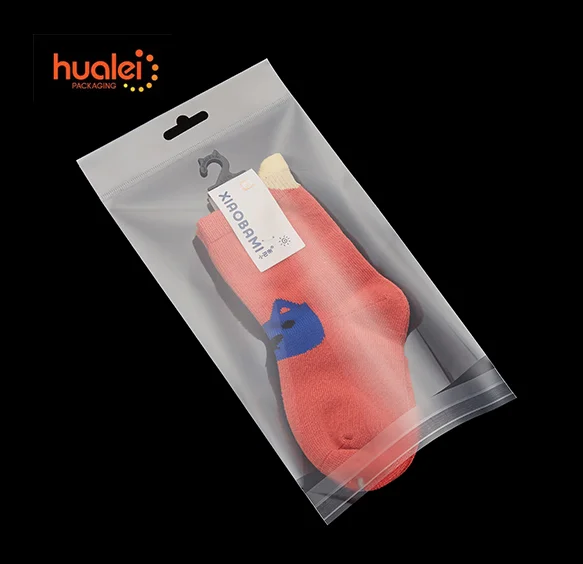
Process control is a key in packaging industry to guarantee the stability of the products. Generally speaking, manufacturers with long years of experience are always more cautious at all levels of the production process, from the sourcing of materials to the final shipping of products. Yiwu Hualei Packaging Co., Ltd., founded in 1998 with large-scale production capacity, offers a broad variety of flexible packaging products. This Socks Bag is most popular for apparel packaging, which is also available in different sizes and thicknesses, and also can offer printing customization. By looking into the production products and the experience of a packaging manufacturer, you will really understand the importance of material and process control in packaging.
Why Production Process Matters in Sock Packaging Bags?
Before we dive into the nitty-gritty of plastics and engineering, it’s helpful to remember that bag problems are customer problems. There are three major ones that customers usually have to deal with. 1. Bags can puncture and develop leaks during transportation. 2. Bags can be stuck to other bags in the packaging material, or stuck to other items inside a packing box. 3. Opacity of the bag can degrade and become more hazy over time, all after the customer has taken possession of the bag. None of these are too easy to “fix” after they occur.
Uncontrolled production can cause a variety of problems. BOPP film commonly used in packaging applications is a transparent, colourless and odourless material with high tensile and impact strength. If the production process is controlled this material of film prevents dust and moisture from coming in between the socks and keeps the socks visible and always fresh and appealing.
An unstable process means that even good material cannot provide a stable product performance. It is therefore more relevant to focus on production than to argue about price.
Raw Material Selection The Foundation of Durable Socks Bags
A packaging bag always begins with some type of raw material. The possible designs and possibilities for a final product are largely determined at this stage.
Common Buyer Pain Point Bags Tear Easily or Look Cheap
Cheap carryout bags will often prove to be too soft and will not maintain an even distribution of width. These poor quality bags will lack clarity and will appear to be “cloudy”. The reasons for these quality control issues that are most commonly found in large quantities of low cost carryout bags are the use of inexpensive polypropylene resin and inadequate mixing of the resin prior to bag production.
The quality of the starting materials and their homogeneity has a direct impact on the tensile strength, optical transparency and service life of bionic glass. Irregularities in the material that occur early on in the manufacturing process are often not detectable later on in the production line and can in no way be compensated out.
Solution High Quality BOPP Film from Reliable Manufacturers
BOPP film used in many fields. After biaxial stretching, the molecules are more regular and strong, flexible and transparent. The moisture resistance provided by the packaging film helps to keep the feet of the socks clean and dry during storage and transportation.
Choose from a range of thicknesses to match the strength of the packaging to the weight of your product. For example you may prefer to use a thin bag for lightweight items like individual pairs of socks; or a thicker heavier bag to give extra protection when packaging in bulk.
Film Extrusion and Biaxial Orientation Enhancing Strength and Clarity
After we choose raw materials, the film production stage is very critical to the final quality of the bag.
Start by melting and extruding polypropylene into a sheet. Cool the sheet rapidly to a low crystallinity state before stretching. Next, stretch the film in both directions to align the molecular structure for improved strength, impact and flexibility.
This step also increases the transparency of the product. High-quality BOPP film offers high transparency that enables clear visibility of the product packaged inside. In the context of the Sock packaging, this step is far more important than one might think. The clear visibility allows for easier identification of the style, color, etc. of the product.
One other aspect of Yiwu Hualei Packaging Co., Ltd.’s manufacturing process is drying before extrusion. Any moisture that remains in the materials can lead to unwanted reactions while they are being processed. By drying the materials completely before undergoing extrusion, we help to ensure that the final product – the film – is as free as possible from defects and more resistant to degradation.
Printing and Customization Turning Packaging into a Branding Tool
Once the film is created it is then printed and converted into a packaging material that helps to reinforce a brand.
Printing on plastic film is not always straightforward. Untreated BOPP has a low surface energy, which makes it difficult for ink to adhere to the film. Without adequate treatment, the printed design can smudge, run or peel, which can lead to a short product life.
Common Buyer Pain Point Blurry Printing or Weak Brand Identity
Some packaging is unclear due to faint or uneven colours on the logo. This can impact consumer perception of the product and can be a concern in a retailer environment where packaging is a key point of purchase.
Solution High Definition Printing and Custom Design Support
Following a corona treatment to ensure an optimal printing quality, the film can be printed using for example gravure technology. The corona treatment increases the surface tension, so the ink can stick to the surface much better. With gravure technology, you can achieve a high-quality transparency and detail in the print patterns.
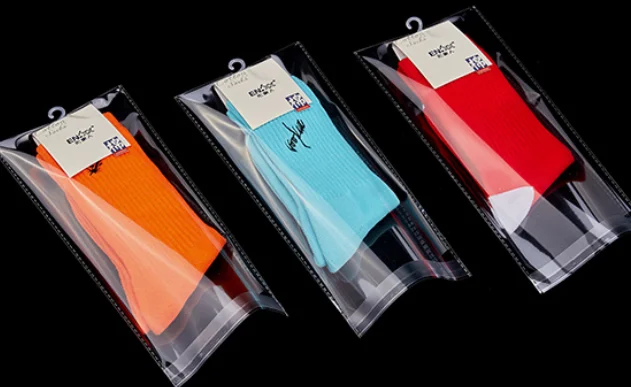
This stage in the packaging process is focused on marketing the product through its packaging. Clean print, suitable color contrast and a correct layout can for example turn a basic product like a pair of socks into an attractive product for the customer.
Bag Conversion Process From Film Rolls to Finished Socks Bags
The film has been printed and is currently available as a roll film. It must be processed into bags.
Packaging bags are formed using machine cutting, folding and sealing processes. Every stage of this process has to be executed flawlessly and uniformly. An imperfect cut can result in a wider range of bag dimensions than intended. Should the sealing point not adhere to the required standard, there is a high likelihood of the bag opening while in transit.
Self-adhesive closures are commonly used for sock packaging. They are a quick and convenient way to seal large quantities of products in a short period of time. This results in a huge saving of time in the warehouse.
It is the closure system we featured on the Socks Bag. Very easy to pack by hand, but also suitable for automation.
Quality Inspection How to Ensure Every Socks Bag Meets Standards?
Even with high levels of automation on production, quality inspection still remains an important stage. In fact, the quality control is also important stage prior to dispatching materials.
Common Buyer Pain Point Inconsistent Quality in Bulk Orders
In large orders sometimes there may be some irregular thickness in the bags or a seal that is weaker than normal. The fact that they are not always easy to see does not mean they are not there and can only really be noticed when the bags are being used.
Solution Multi Stage Quality Control Systems
Normal Quality control procedures entail various stages. Thickness is verified to ensure uniformity. Seal strength is verified to ensure durability. The Print is verified for legibility and correct alignment.
BOPP film must be left to rest for a period of time so that the internal stresses can come out. This is a stage called aging. Without this stage the film can expand, deform, during storage and use.
Larger manufacturers tend to have better quality control because their processes are more robust and less prone to variation due to the higher volume of material being produced.
Final Packaging and Delivery Ensuring Safe Global Shipping
A cover is used in order to shield the bags against dirt and from compression during transportation which is particularly important in the case of international transportation because of the prolonged time that a shipment is in transit.
Reliable sources will be able to provide a history of having shipped materials overseas. This should aid in any difficulties arising from the shipping aspects of the export process and also ensure that the materials are delivered in a condition acceptable to the buyer.
How to Choose the Right Socks Bag Manufacturer for Your Business?
Choosing a supplier is not just about price. A number of other things need to be taken into account.
You want your materials to be consistent in quality and fit for purpose for your products. Your supplier’s production capacity should be able to meet your required order volumes. You want options for finishing or packaging to match your requirements for branding. You want reliable lead-times for your materials.
The company experience is also important. Companies with longer backgrounds have more developed processes and higher quality control.
When you bring together all these packaging elements, your packaging becomes a reliable component of your supply chain.
FAQ
Q1: What material is commonly used for socks packaging bags?
A: BOPP film is used often due to its transparent and strong films with high moisture resistance properties which is suitable for clothing packaging.
Q2: Why do some packaging bags tear easily?
A: This is generally due to poor quality of raw materials or inadequate stretching during the manufacturing process that leads to a reduction in strength and longevity.
Q3: Can socks packaging bags be customized with logos?
A: Is BOPP film suitable for labeling, after surface pretreatment, our BOPP film can be used for high-quality printing and with clear logos and designs.
Q4: What thickness is suitable for socks bags?
A: Thickness will vary depending on the product. In the case of lightweight socks we will use a thinner film, while in the case of bulk packaging, we may have to use a thicker film in order to give adequate protection.
Q5: How can consistent quality be maintained in bulk orders?
A: Consistent quality is directly linked to stable input materials, uniform production processes and adequate control of dimensions, such as thickness, and the seal strength of the seal.